Open your notes app right now and scroll back three weeks. Be honest: how much of that would you actually reread before an exam? For most students, the answer is close to none. You wrote it down once, closed the tab, and never opened it again. The notes exist. They're just not doing anything.
That's the real problem with most note-taking, and it has nothing to do with which app you use or whether you write in cursive. The problem is that most notes are built to be written, not to be used.
Notes are supposed to be a tool, not a filing cabinet
A useful way to think about this comes from research on modern note-taking systems: most note-taking stores information but rarely improves memory on its own. Writing something down and filing it away is a storage act. It's not the same thing as learning it, and it doesn't automatically set you up to learn it later either. Notes only become useful when you go back and actively do something with them — revisit them, connect them to other ideas, or, most importantly, test yourself against them.
There's a simple filter you can apply to any note you're about to write, sometimes called the reuse test: could this note answer a question, settle a decision, or explain an idea on its own, weeks from now, with no other context? If not, you captured text. You didn't create a useful note. This single filter eliminates most of the bad habits that make notes pile up unused — the verbatim transcription, the fragments that only make sense in the moment, the half-sentence you'll have no memory of by finals week.
The handwriting-vs-typing debate is real, but not for the reason people think
You've probably heard that handwriting beats typing for retention. That claim traces back to a well-known 2014 study, The Pen Is Mightier Than the Keyboard, in which students who took notes on laptops performed worse on conceptual questions than students who wrote longhand. It became one of the most cited findings in education research and led a lot of schools to restrict laptops in lecture halls.
Here's the part that gets left out of most summaries: a 2019 direct replication of that study found the effect didn't reliably hold up. Performance didn't consistently differ between longhand and laptop note-takers — and in one experiment, it didn't even differ from a group that took no notes at all. The honest read of the research isn't "pen beats keyboard." It's that the original explanation was probably right even though the specific advantage wasn't as reliable as first reported.
That explanation matters more than the medium. The original researchers found that laptop note-takers tend to transcribe lectures nearly word-for-word, because typing is fast enough to make verbatim capture possible. Handwriting is slower, so it forces you to summarize and paraphrase in real time instead of transcribing — and that act of reframing information in your own words, not the pen itself, is what seemed to drive the difference. Which means the real lesson isn't "switch to paper." It's: whatever you're using, stop transcribing. If you can type or write fast enough to capture something verbatim, you're capturing it too passively to remember it.
Cornell notes work because they build in a test, not because of the layout
The Cornell method — a page split into a notes column, a narrow cues column, and a summary section at the bottom — gets recommended constantly, and it's genuinely useful, but the layout isn't really the point. What makes it work is that it forces you to generate cue questions from your own notes shortly after writing them, which is a built-in low-stakes self-test. You're not just storing the lecture. You're immediately converting it into something you can quiz yourself with later.
That detail is the actual mechanism behind almost every "good" note-taking method, whatever it's called. Outlining, mapping, charting — they all fail equally if you write them once and never touch them again. They all work better the moment you build in a step where you have to retrieve the information rather than just reread it.
Why review matters more than the note-taking method itself
This is where the research gets less about note-taking specifically and more about memory generally, and it's worth understanding because it explains why so many "well-organized" notes still don't stick. In a now-classic set of experiments, psychologists Henry Roediger and Jeffrey Karpicke had students either reread a passage repeatedly or read it once and then try to recall it from memory with no notes in front of them. Right after studying, the re-readers looked like the clear winners. A week later, the pattern flipped — students who had tested themselves on the material retained significantly more than those who had only reread it, and the gap showed up consistently at both the 2-day and 1-week mark.
Translate that to notes: rereading your notes the night before an exam feels like studying, and it will make you feel confident. That confidence is somewhat misleading. The version of "studying your notes" that actually builds retention is closing them and trying to answer, from memory, the questions they were supposed to teach you.
A note-taking workflow that's actually built to be reused
Put together, the research points toward a fairly simple system:
- Capture in your own words, not verbatim. If you're writing fast enough to transcribe, slow down or switch to a faster-to-summarize format like bullets and abbreviations.
- Add a cue or question next to each key point, either during class or within a few minutes after — this is the Cornell instinct, and it's the step most students skip.
- Convert your notes into test material within 24 hours, while the lecture is still fresh enough that you can tell whether your notes actually make sense out of context. This is also the point where the reuse test is easiest to apply honestly.
- Review by testing, not rereading. Close the notes and try to answer your own cue questions from memory. Only flip back to check.
- Space it out. A quick self-test a day after class, then again a few days later, beats one long review session the night before — even if the total time spent is the same.
None of this requires special tools. But the step everyone skips — turning raw notes into testable material — is exactly the step that takes the most time to do by hand, which is why it's the step that gets skipped most often when a deadline is close.
What this looks like in practice
Picture two students in the same intro psych lecture, both taking notes on the same slide about operant conditioning. One writes down close to everything the professor says, in full sentences, trying to keep up: "Operant conditioning is a learning process through which the strength of a behavior is modified by reinforcement or punishment. It was developed by B.F. Skinner..." By the end of the slide, they're three sentences behind and still catching up.
The other writes: "Operant conditioning = behavior shaped by consequences (Skinner). Reinforcement ↑ behavior, punishment ↓ behavior." Next to it, in the cue column: "What's the difference between reinforcement and punishment?" That's it. Four seconds of writing instead of forty.
The first student has more words on the page and a more complete record of what was said. The second student has less text but a question they can actually quiz themselves with a week later — and notes short enough that rereading them doesn't turn into a rereading trap. When exam week comes, the second student's notes function as a stack of self-test prompts. The first student's notes function as a transcript they'd have to re-process from scratch, which is exactly the kind of passive rereading that research says does the least for retention.
Common mistakes that quietly make notes useless
A few habits are worth watching for specifically, because they're common enough to be the default rather than the exception:
- Transcribing slides word-for-word. If the professor already wrote it down and posted the slides, copying it again adds nothing. Write what the slide doesn't say — the example that clarifies it, the connection to last week's material, the thing you almost didn't understand.
- Writing notes you'll only understand in the moment. A note like "important — this is on the test" means nothing three weeks later without the context of why. Write the actual reason.
- Never revisiting notes until the week of the exam. By then you're not reviewing, you're relearning — closer to reading the chapter for the first time than reinforcing something you half-remember.
- Treating a full page as progress. Volume of notes and quality of notes are only loosely related. A page of vague summary is worth less than three lines with a sharp cue question attached.
- Keeping notes in a format that's painful to review. If opening your notes app feels like a chore, you won't do it consistently, and consistency matters more than the specific method you use.
Where Lurna fits into this
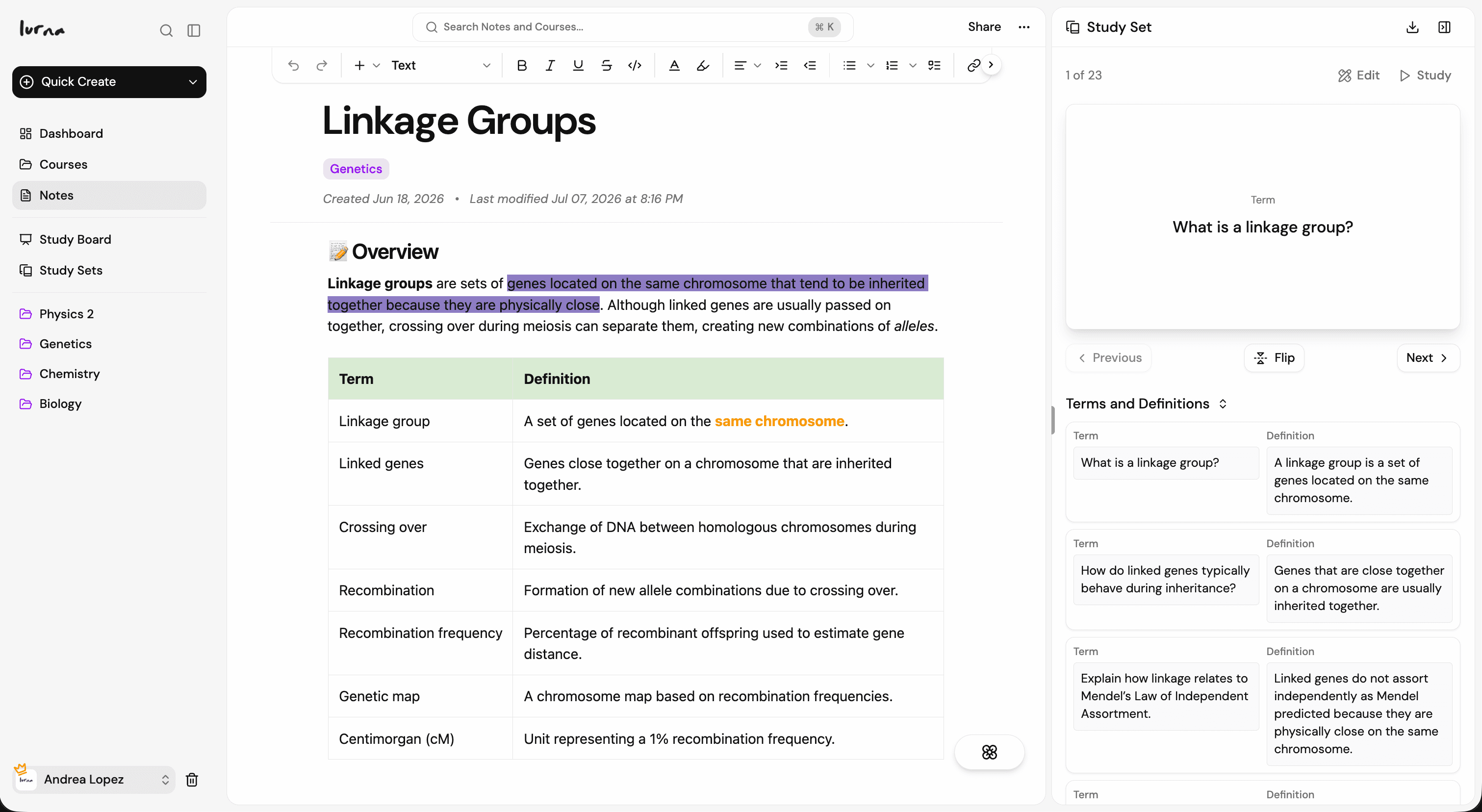
This is the specific gap Lurna is built to close. Feed it your notes and it generates flashcards or a quiz from them directly — turning the raw capture from lecture into the retrieval-practice step that research keeps pointing to as the part that actually builds memory, without the extra hour of manually writing questions for every page of notes. It's not a replacement for taking good notes in the first place. It's what makes the notes you already took worth revisiting.
The notes you'll actually use later aren't the neatest ones or the most detailed ones. They're the ones you built with a test already inside them.
Try it at app.lurna.co.