Almost every student is using AI to study now. Adoption surveyed globally hit 92% in 2025, up from 66% just a year earlier, and a February 2026 Coursera survey of over 4,200 students and educators found usage on U.S. campuses is now close to universal. That part of the story is settled. Almost everyone has the tool open.
What's not settled — and what actually matters for your GPA — is what they're doing with it once it's open. That gap, between using AI and using it well, is where this whole conversation actually lives.
The adoption number is misleading
It's tempting to read "92% of students use AI" as evidence that AI is obviously working. It isn't evidence of that at all. Adoption measures whether the tab is open. It says nothing about whether what's happening in that tab builds a memory or just borrows one for twenty minutes.
The same Coursera survey that reported near-universal use also found that only 20% of universities have a formal AI policy, and roughly half of students and educators think higher ed isn't prepared to manage AI's impact. Mass adoption arrived faster than anyone figured out how to use it well — which means most of that 92% is improvising.
What most students are actually doing (and why it doesn't stick)
The default AI study session looks like this: paste in a chapter, ask for a summary. Paste in a problem set, ask for the answer. Ask a chatbot to explain a concept you didn't quite follow in lecture. All of this feels like studying. It produces an answer. It even feels efficient, because it is efficient — at producing an answer.
The problem is that producing an answer and learning the material are different cognitive events. Research on how students are actually using AI in 2026 found that the most common uses — summarizing material, checking homework, and asking explanatory questions — are also the least effective at building durable retention. A smaller group of students, using AI differently, are getting meaningfully better outcomes. The gap between those two groups is now large enough to show up in exam results.
A USC study on how students are using AI landed on a similar conclusion: left unguided, most students default to using AI as a shortcut around the work rather than a way through it. The tool isn't the variable here. The default use case is.
The pattern that actually moves grades
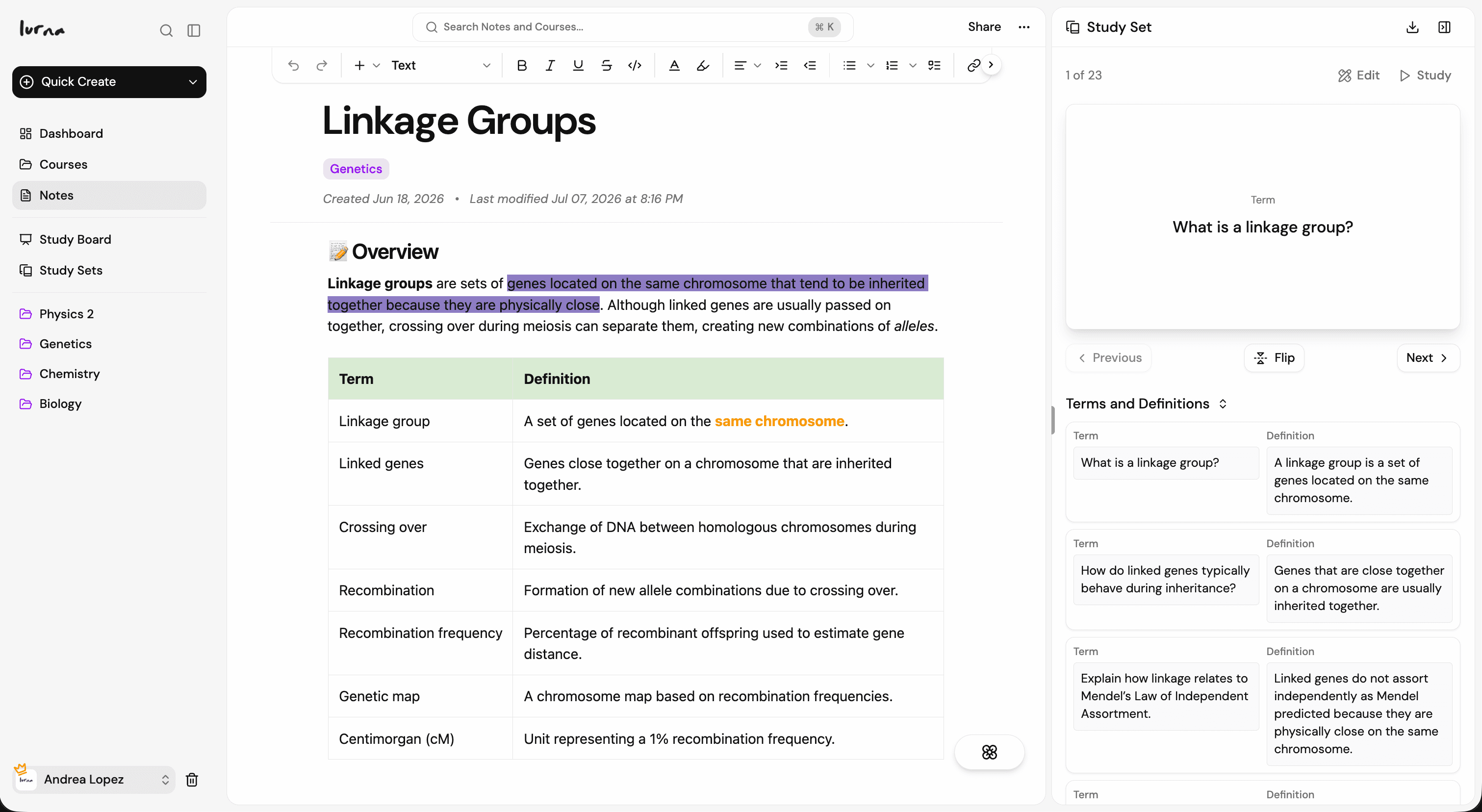
The AI study pattern that's consistently tied to real improvement isn't summarization or explanation. It's retrieval practice — feeding AI your own notes or course material and having it generate practice questions, flashcards, or problem sets, then testing yourself against them without looking at the source. That forces your brain to do the thing exams actually require: produce the answer from memory, under mild pressure, with no safety net.
This isn't a new idea AI invented — retrieval practice and spaced repetition have been core to learning science for decades. What's new is that AI removes the bottleneck that used to make this pattern impractical. Building a solid flashcard deck or a self-quiz from forty pages of lecture notes used to take real time most students didn't have during finals week. Now a model can do the mechanical part — the deck-building — in seconds, and the student gets to spend their limited time on the part that actually builds memory: retrieving.
Picture two students prepping for the same anatomy exam. One pastes their lecture slides into a chatbot and asks it to explain the brachial plexus. They read the explanation, it makes sense, they move on. The other takes the same slides and has AI turn them into flashcards, then quizzes themselves until they can name each nerve without looking. Both spent twenty minutes "using AI to study." Only one of them will be able to name the brachial plexus cold in three weeks, because only one of them was ever forced to retrieve it.
The honest caveat: AI can also make this worse
It would be dishonest to stop there, because the research doesn't stop there. A major Brookings Institution report released in January 2026, based on a year-long global study across more than 50 countries, concluded that under current patterns of use, the risks of generative AI for students currently outweigh the benefits. The central concern isn't the technology — it's cognitive over-reliance: when AI does the thinking, the reasoning and problem-solving skills that exams and real coursework demand never get built.
This tracks with what shows up in the grade data. Students who use AI to generate their assignments rather than to understand the material tend to see their assignment grades hold up fine while their exam and test scores quietly fall behind — a diagnostic gap that's often the clearest sign a student has drifted into using AI as a shortcut rather than a study tool.
There's a useful contrast buried in the Khan Academy data here too, referenced in recent reporting on AI and student grades: its AI tutor Khanmigo, which is built to ask guiding questions instead of handing over answers, produced meaningfully better outcomes than a standard chatbot precisely because it refuses to just tell students what they want to know. The structure of the tool — retrieval and guided struggle instead of direct answers — is what made the difference, not the underlying AI itself.
So both things in this piece are true at once. AI, used as an answer machine, can quietly erode the skills you're supposed to be building. AI, used to generate retrieval practice from material you've already engaged with, is one of the more genuinely useful study tools to show up in years. The tool doesn't decide which of those happens. The use case does.
This isn't the same conversation as "using AI to cheat"
It's worth being explicit about this, because the two get conflated constantly. Using AI to generate practice questions from your own notes and quiz yourself is not the same activity as using AI to write an essay you turn in as your own work. The distinction that actually matters academically isn't "did a student touch an AI tool" — it's whether the AI did the thinking that was supposed to be assessed. A student who spends two hours a week using an AI tutor for practice problems is building real skill. A student who has AI generate a submission is not, regardless of how the grade turns out in the short term.
That distinction also shows up in a less obvious place: who gets to use AI well in the first place. Recent survey data highlighted what researchers are calling a "shadow" literacy gap — students from better-resourced backgrounds are significantly more likely to use AI for higher-order tasks like structuring research and building study systems, while other students, often without formal guidance from their school, default to surface-level use like basic summaries. Only about a third of students report getting any formal training on how to use AI effectively. In other words: the students who most need a structured, effective study pattern are the least likely to stumble into one on their own. That's less an argument against AI and more an argument for tools that build the effective pattern in by default, instead of assuming every student will independently discover retrieval practice on their own.
How to actually do this
None of this requires a complicated system. The shift is smaller than it sounds:
- Stop asking AI to explain things you haven't tried to work through yourself first. Attempt the problem or recall the concept cold, then use AI to check your work or fill the specific gap — not as the first move.
- Turn your own notes into practice material immediately after class, while the material is still fresh, rather than waiting until the night before the exam to build a study tool from scratch.
- Quiz yourself without the source material open. If you're re-reading the answer while "testing" yourself, it isn't retrieval practice — it's re-reading with extra steps.
- Space it out. Reviewing material a day or two after first seeing it, then again a few days later, beats a single long cram session even if the total study time is identical.
- Treat AI-generated explanations as a last resort for the specific thing you're stuck on — not a substitute for trying first.
None of these steps require a special tool. But they all get meaningfully easier when the tool you're already using is built around generating practice material instead of generating answers.
Where Lurna fits into this
This is exactly the gap Lurna is built for. Feed it your notes or a topic and it generates flashcards, structured study notes, or a quiz from that material — the retrieval-practice loop the research keeps pointing to as the pattern that actually works, without the hour of manual deck-building that used to make it impractical during a busy week. It's not built to explain the material to you instead of you learning it. It's built to get you testing yourself on it, faster, so the friction between "I should really make flashcards for this" and actually having them disappears.
That's the honest version of AI empowerment for students. Not a shortcut around learning. A faster path to the part of studying — retrieval, repetition, self-testing — that was always the part that actually worked, but that nobody had time to set up properly before.
Try it at app.lurna.co.