You read the chapter. You reread it. You reread it again the night before the exam, and by the third pass it feels smooth — familiar, almost easy. You close the book feeling ready. Then you sit down for the test and blank on a question you were sure you knew an hour ago.
That gap between "this feels familiar" and "I can actually produce this from memory" is the entire story of why rereading fails and active recall works. It's not a motivation problem or a smarts problem. It's that rereading and recall are training two different skills, and only one of them is the skill exams actually test.
The research verdict isn't close
This isn't a matter of opinion. In 2013, four cognitive and educational psychologists published a comprehensive review of ten common study techniques, rating each one's utility based on the available evidence. Rereading — along with highlighting and underlining, the two other most commonly used study habits — was rated low utility. Practice testing, meaning any form of actively retrieving information from memory rather than looking at it, was rated one of only two high-utility techniques, alongside distributed practice (spacing study out over time).
That finding wasn't a fluke of one study. A 2021 meta-analysis covering 242 separate studies and over 169,000 participants confirmed the same ranking at much larger scale: practice testing and distributed practice came out as the most effective learning techniques measured, while rereading and highlighting — despite being the techniques students report using the most — landed near the bottom. As researchers at Kent State summarized it, quizzing yourself on material before a test is a highly effective strategy that's been repeatedly demonstrated across students of nearly every age group, while several of the most popular habits students actually reach for don't hold up nearly as well.
Rereading isn't rare or fringe. It's the default. Most students genuinely believe it works, which is exactly why it's worth understanding why it doesn't.
Why rereading fools you: the fluency illusion
Rereading doesn't fail because nothing happens when you do it. Something happens — the text gets easier to process each time you see it. That ease is called fluency, and it's the entire problem. Your brain interprets "this is easy to process" as "I understand this," even though fluency is a marker of recognition, not recall. Recognizing a fact when you see it again and producing that same fact from nothing are different mental operations, and only the second one is what most exams actually demand.
This is sometimes called the illusion of competence, and it's well documented in cognitive psychology going back to research on how learners judge their own knowledge during study. Recognition can feel identical to recall in the moment even though it requires far less actual retention — which is exactly why a student can reread a chapter three times, feel completely confident walking into an exam, and then freeze on a question that requires generating the answer from scratch rather than picking it out of a lineup. The confidence was real. It just wasn't measuring the right thing.
What active recall actually is (and why it feels worse while working better)
Active recall means closing the material and trying to produce the answer from memory — no peeking, no partial credit for "I recognize this." A flashcard you flip immediately without attempting an answer first isn't active recall. Neither is reading a question and then re-reading the notes to find the answer. The retrieval attempt has to happen before you look.
This is the exact mechanism behind one of the most cited findings in learning science. In a now-classic pair of experiments, researchers Henry Roediger and Jeffrey Karpicke had students either reread a passage several times or read it once and then try to recall as much as possible with nothing in front of them. Right after studying, the students who reread performed better — but a week later, the group that had tested themselves outperformed the rereaders by a wide margin, with the advantage holding at both the two-day and one-week mark. The technique that felt worse in the moment produced the retention that actually lasted.
That's not a coincidence — it's a well-established pattern researchers call a "desirable difficulty." Recall is harder than rereading because you're doing real cognitive work: searching memory, reconstructing the answer, tolerating the discomfort of not being sure. That effort is exactly what strengthens the memory. Rereading skips the effort, which is why it feels easier and produces less.
A side-by-side example
Two students are studying the same biology chapter on cellular respiration, the night before a quiz.
Student A reads the chapter, then rereads the section on the electron transport chain twice more because it's confusing. By the third pass, the paragraph flows smoothly, the diagram looks familiar, and the vocabulary doesn't trip them up anymore. They feel ready.
Student B reads the chapter once, closes it, and tries to write out — from memory — the steps of the electron transport chain and what each stage produces. They get stuck twice, check the book, and try again from the point where they got stuck rather than rereading the whole section. By their second attempt, they can get through it with only one small gap.
Student A spent more total time and finished feeling more confident. Student B struggled visibly and knew exactly where their gaps were. On a quiz the next day that asks them to explain the process rather than recognize it from a word bank, student B has a real advantage — not because they're smarter, but because they're the only one who actually rehearsed producing the answer instead of recognizing it.
How to actually switch from rereading to recall
The shift doesn't require new tools, just a change in what you do with your existing material:
- Close the notes before you try to answer anything. If the source is open while you're "testing" yourself, you're rereading with extra steps.
- Turn headings and key terms into questions. Instead of rereading "the electron transport chain produces ATP through a series of redox reactions," ask yourself "what does the electron transport chain produce, and how?" — then answer it cold.
- Get comfortable being wrong in practice. Getting an answer wrong during a low-stakes self-test is the mechanism working, not a sign you're behind. The gap it reveals is exactly what you needed to find before the real exam did it for you.
- Space the retrieval attempts out. Testing yourself once right after class, then again two days later, then again before the exam, builds more durable memory than one long recall session — the same distributed-practice effect that earned a high-utility rating alongside practice testing.
- Use flashcards correctly. A flashcard only counts as active recall if you attempt the answer before flipping it. Flipping immediately to "review" the answer is closer to rereading than testing.
Common mistakes that quietly turn "active recall" into rereading
Active recall is easy to do badly without realizing it, because the bad version still feels like the good version:
- Flipping the flashcard too fast. If you glance at the front and flip within a second because the answer "feels" close, you're pattern-matching on familiarity, not retrieving. Force a real attempt, even a wrong one, before you look.
- Rereading the question and the notes side by side. If the source material is visible while you're answering, you're not testing memory — you're doing a slower version of rereading with a question mark attached.
- Only recalling what's easy. It's tempting to quiz yourself on the material you already know well, because getting it right feels good. The material worth testing yourself on is the material you're least sure about — that's where the technique actually earns its keep.
- Multiple choice as a stand-in for real recall. Recognizing the right answer in a list of options is a much easier task than producing that answer from nothing, which is why students who ace practice quizzes with answer choices sometimes freeze on an essay question that offers no options at all. If your real exam requires free recall, practice free recall.
- Doing it once and calling it done. A single retrieval attempt helps, but the research on distributed practice is clear that spacing retrieval attempts out over days produces meaningfully more durable retention than doing it all in one sitting, even at the same total time investment.
Where Lurna fits into this
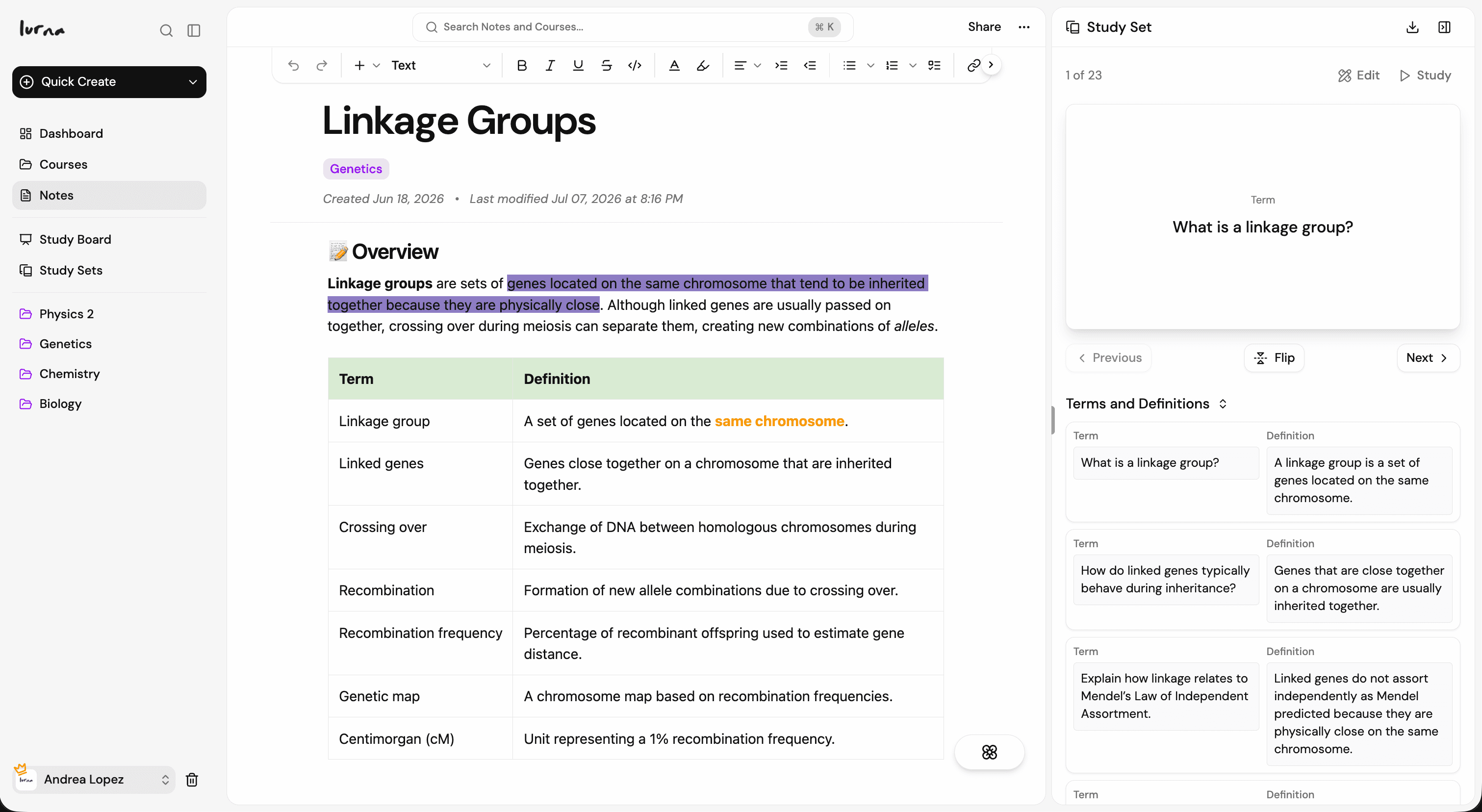
The hardest part of switching to active recall isn't understanding why it works — it's the setup cost. Rereading requires nothing but the material you already have open. Active recall requires turning that material into questions first, which takes real time most students don't have during a busy week, which is exactly why rereading stays the default despite being the weaker method.
This is the specific gap Lurna is built to close. Feed it your notes or a topic and it generates flashcards or a quiz directly from that material, so the retrieval-practice step — the one the research consistently points to as the technique that actually works — doesn't require an extra hour of manually writing questions before you can even start studying the right way.
Rereading will always feel like the easier option, because fluency is designed to feel like understanding. The gap only shows up on the exam. Active recall costs more up front and pays out exactly when it matters.
Try it at app.lurna.co.